
Anti-Heroes and Alter Egos
Swifties will recognise the lyrics from Anti-Hero, a song by Taylor Swift about the fear that your own worst enemy is yourself (1). Maybe it’s a mirrored reflection of you, another version of you, a piece of you, or perhaps it’s all of you when in different circumstances – like Taylor who fears being “left to [her] own devices [because] they come with prices and vices”. We see this narrative in Dostoevsky’s The Double where Golyadkin encounters a charismatic and successful version of himself – or more broadly, everything he is not – who slowly replaces him in society (2). This idea is similarly found in the first book of The Bible (3), where Jacob wrestles with ‘a man’ over the course of the night. Yet Jacob is said to have been alone, so who was he wrestling with? We have plenty of other examples of an internal struggle leading to self-sabotage: Stevenson’s Dr. Jekyll and Mr. Hyde (4), Tolkien’s Gollum and Sméagol (5), Fight Club’s Tyler Durden and The Narrator (6), Edgar Allan Poe’s William Wilson (7). This is the narrative used by thinkers and practitioners of Science and Non-Science in how they view one another: mutually repulsed by a grotesque reflection of their own inadequacies, insecurities, and unchecked limitations.

Image description: Seymour Skinner, the school principal from The Simpsons and fictional Vietnam war veteran, demonstrates he like Taylor Swift in Anti-Hero can “stare directly at the sun but never in the mirror”.
Pot, meet Kettle
For each example above, both Science and Non-Science view themselves as the protagonist in the pursuit of what is true, attributing the other as their arrogant, foul, and uncanny doppelganger – perhaps unwittingly. For what ‘Normal Science’ (8) accuses Non-Science of are the fears it has about itself: the potential for subjective bias, unfalsifiability (9), and a disregard for empirical evidence. By the same token, Non-Science looks at Science and sees their own fears reflected back: extreme reductionism, loss of deeper meaning, and the illusion of certainty.

Culture in the Lab
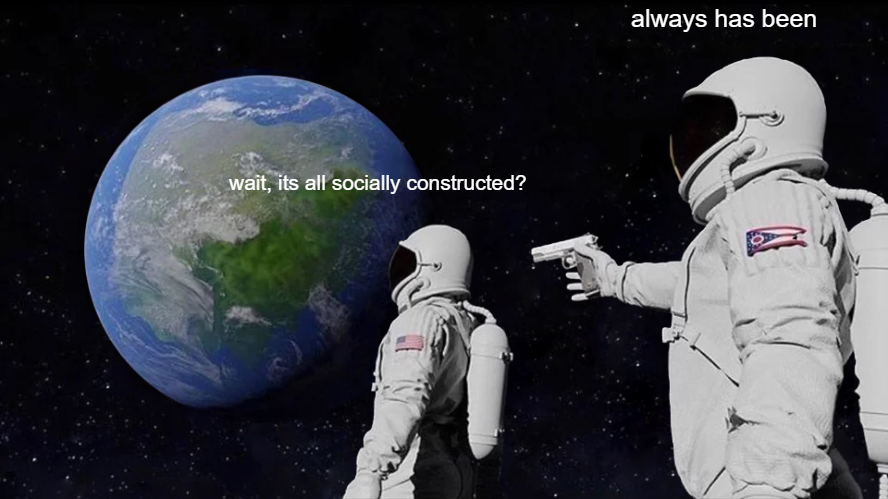
While Science prizes objectivity, both it and Non-Science are socially constructed. Scientific knowledge is shaped by social, historical and cultural contexts (8,10). Consider germ theory’s delayed acceptance due doctors protecting their authority (11,12,13), homosexuality’s classification as a mental disorder until 1973 (14,15,16,17), and eugenics discredited following the horrors of World War II (18,19,20). Each shifted through changing social attitudes, not empirical scrutiny alone. There is no “view from nowhere” from which Science can exist or practice (21).
The Author: Dead and Buried, Yet Haunting
Non-Science has also come up short when measured against its own ideals. One example is reducing Barthes’ Death of the Author (22) from questioning the centralisation of authorial intent towards a rigid formula of dismantling authorial intent, thereby automatically dismissing any authorial context. We find irony in New Criticism engaging in exactly the kind of absolutist thinking Barthes was arguing against (23,24). Absolute authority of meaning isn’t dismantled, but shifted from a single individual to the pluralist many; the ‘correct’ way to understand a text becomes considering its innumerable interpretations, an elegant impossibility equal to definitively knowing a long-dead author’s true intention. Understanding Barthes’ biographical context helps illustrate his move from structuralism to post-structuralism, and the interplay between the two, which is lost in reductionist readings (25).
Reflections on Dichotomy
So where can we find reconciliation between the two halves of epistemological inquiry, Science and Non-Science, so that they do not meet the same fate as William Wilson, stabbed to death by himself? (7). Take Dualism, found in Science as wave-particle duality and demonstrated by Young’s double slit experiment (26). Some subatomic particles, like photons and electrons, exhibit both wave-like and particle-like behaviour depending on the observation method. If light is measured like a wave, it exhibits wave-like properties. But if it is measured like a particle, then it exhibits particle-like properties. This understanding that objects hold paradoxical properties of which a subset are realised through interaction echoes Heraclitus’ Unity of Opposites from around 500BCE (27). He cites sea water as being both pure and polluted: for fish it is life-giving while for humans it is undrinkable and deadly (28), and notes how bows and lyres both function through the interaction of opposing states: tension and release of a string (29).
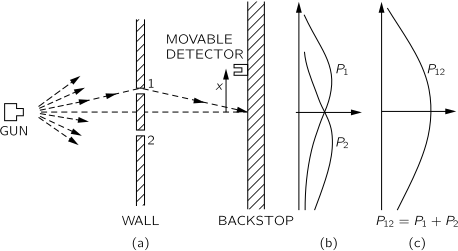
Fig 1-1 shows how we see particles (such as bullets) passing through the double-slit: we see two distinct maxima in line with the two slits. (36)
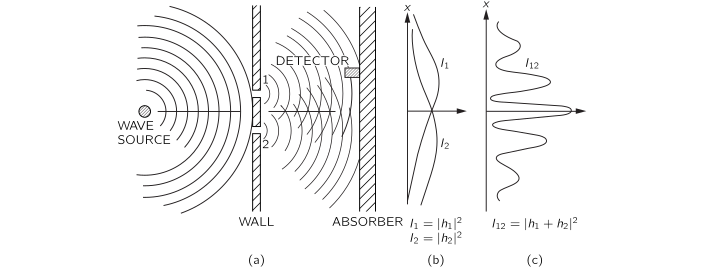
Fig 1-2 shows how we see waves passing through the double-slit: we see construtive and destructive interference resulting in a series of maxima (ie peaks of high intensity light) and minima (ie troughs of no light). (36)
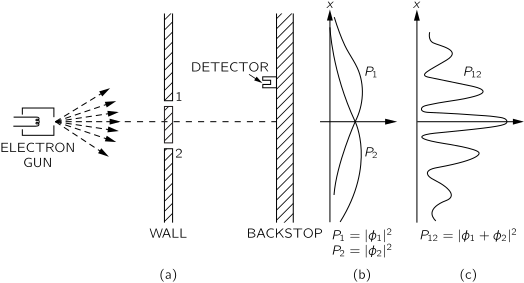
Fig 1-3: We expect electrons to behave like particles, but Fig 1-3 shows how electrons exhibit wave-like properties of constructive and destructive interference. (36)
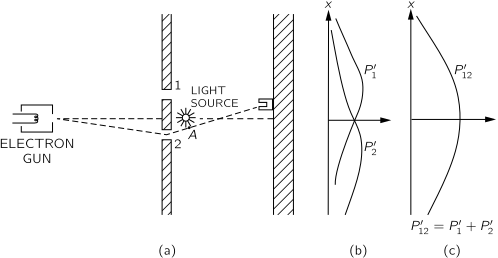
Fig 1-4 shows how when we then try to measure which slit the ‘electron particle’ goes through (ie using a light source), the quantum system breaks down and exhibits particle-like interference properties. (36)
Complex Causality is another area of reconciliation. Science knows this as The Observer Effect, demonstrated in Anthropology by the Hawthorne Effect (30,31) and in Physics by the Heisenberg uncertainty principle (32,33). The first details that human behaviour changes if aware of observation, while the second details how knowing more about the momentum of a quantum entity (eg a photon or electron) results in knowing less about its position in space – knowing both with high precision is not possible. Non-Science recognises complex causality in reader-response theory: the reader’s interpretation, and thus background, experiences, and feelings interact with the author’s text to shape the meaning of the work (34,35).
Video description: A goofy but brief explainer on Young’s Double Slit Experiment and Heisenberg’s Uncertainty principle.
Both/And: Beyond the Binary
In the margins of Young’s empirical evidence, the answer to “is light a wave or a particle?” becomes: “Both!”. Or more cautiously, “It depends”. Isn’t this an answer we would expect from the Humanities or Non-Science? Frankly, the answer reveals to us that our question is nonsensical; it depends on the assumptions made behind the question. In light of Reader-response theory, the answer to “does meaning arise from the author and their text or the reader and their interpretation?” reflects our last answer: “It depends on both.” Again our question is flawed, or at least incomplete. The differences between Science and Non-Science come from definition in opposition to each other, so the answer to the question: “Is the valid epistemological inquiry Science or Non-Science?” must surely be: Both! And it depends…
Bibliography
- Swift, TA. Anti-Hero. Youtube music video. 2022 Oct 21. https://www.youtube.com/watch?v=b1kbLwvqugk [Accessed 19th January 2025].
- Dostoevsky F. The Double: A Petersburg Poem. Otechestvennye zapiski 1846.
- The Bible. New International Version. Genesis 32:22-32.
- Stevenson RL. Doctor Jekyll and Mister Hyde. St. Paul, Mn: Emc; 1967.
- Tolkien JRR. The Hobbit. London: Harpercollins Children’s Books; 1937.
- Palahniuk C. Fight Club. New York: W.W. Norton & Company; 1996.
- Poe EA. William Wilson. Burton’s Gentleman’s Magazine. 1839 Oct.
- Kuhn TS. The structure of scientific revolutions. 2d ed., enl. Chicago: University of Chicago Press; 1970. 210 p. (International encyclopedia of unified science. Foundations of the unity of science, v. 2, no. 2).
- Popper, K. Conjectures and Refutations. London: Routledge; 1963. pp. 33-38
- Berger P, Luckmann T. The social construction of reality. InSocial theory re-wired 2016 Mar 31 (pp. 110-122). Routledge.
- Richmond PA. American attitudes toward the germ theory of disease (1860-1880). Journal of the history of medicine and allied sciences. 1954 Oct 1:428-54.
- Richmond PA. Some variant theories in opposition to the germ theory of disease. Journal of the History of Medicine and Allied Sciences. 1954 Jul 1:290-303.
- Latour B. The pasteurization of France. Harvard University Press; 1993 Oct 15.
- Hooker E. The adjustment of the male overt homosexual. Journal of projective techniques. 1957 Mar 1;21(1):18-31.
- Drescher J. Out of DSM: Depathologizing homosexuality. Behavioral sciences. 2015 Dec 4;5(4):565-75.
- Wakefield JC. R. Spitzer and the depathologization of homosexuality: some considerations on the 50th anniversary. World Psychiatry. 2024 Jun;23(2):285.
- Drescher J. Queer diagnoses parallels and contrasts in the history of homosexuality, gender variance, and the Diagnostic and Statistical Manual (DSM) Review and Recommendations Prepared for the DSM-V Sexual and Gender Identity Disorders Work Group. Focus. 2020 Jul;18(3):308-35.
- United Nations. Universal Declaration of Human Rights [Internet]. United Nations. 1948. Available from: https://www.un.org/en/about-us/universal-declaration-of-human-rights
- Lee M. Engineering Mankind: The Sociopolitical Impact of Eugenics in America. Voces Novae. 2019;11(1):3.
- National Human Genome Research Institute. Eugenics and Scientific Racism [Internet]. United States Department of Health and Human Services. 2022. Available from: https://www.genome.gov/about-genomics/fact-sheets/Eugenics-and-Scientific-Racism
- Nagel T. The view from nowhere. oxford university press; 1989 Feb 9.
- Barthes R. The death of the author. In: Barthes R. Image-Music-Text. Heath S, translator. New York: Hill and Wang; 1977. p. 142-148.
- Wimsatt WK, Beardsley MC. The intentional fallacy. University of the South; 1946 Jul 1.
- Richards IA. Practical Criticism V 4. Routledge; 2014 May 12.
- Lentricchia F. After the new criticism. University of Chicago Press; 1980.
- Young TI. The Bakerian Lecture. Experiments and calculations relative to physical optics. Philosophical Transactions of the Royal Society of London. 1804 Dec 31;94:1–16.
- Heraclitus Of Ephesus, Haxton B. Fragments : the collected wisdom of Heraclitus. New York: Penguin Books; 2003.
- Heraclitus Of Ephesus, Haxton B. Fragment 52. In: Fragments : the collected wisdom of Heraclitus. New York: Penguin Books; 2003. p. 35.
- Heraclitus Of Ephesus, Haxton B. Fragment 56. In: Fragments : the collected wisdom of Heraclitus. New York: Penguin Books; 2003. p. 37.
- McCarney R., Warner J., Iliffe S., van Haselen R., Griffin M., & Fisher P. The Hawthorne Effect: a randomised, controlled trial. BMC medical research methodology. 2007 Jul 3(7:30). https://doi.org/10.1186/1471-2288-7-30
- Landsberger HA. Hawthorne Revisited: Management and Worker, Its Critics, and Developments in Human Relations in Industry. Ithaca, N.Y.: Cornell University; 1958.
- Heisenberg W. Über den anschaulichen Inhalt der quantentheoretischen Kinematik und Mechanik. Zeitschrift für Physik. 1927 Mar;Volume 43(3-4):172–98. Translation by NASA, Availible here: https://ntrs.nasa.gov/citations/19840008978
- Heisenberg W. Encounters with Einstein: And other essays on people, places, and particles. Princeton University Press; 1989 Oct 21.
- Harkin P. The reception of reader-response theory. College Composition & Communication. 2005 Feb 1;56(3):410-25.
- Kunjanman S, Aziz AA. Reader-Response Theory: A Systematic Literature Review. Malaysian Journal of Social Sciences and Humanities (MJSSH). 2021 Apr 8;6(4):252–60.
- The Feynman Lectures on Physics Vol. III Ch. 1: Quantum Behavior [Internet]. http://www.feynmanlectures.caltech.edu. Available from: https://www.feynmanlectures.caltech.edu/III_01.html
